
The Challenge
A hardware store earns its keep in person. Someone walks in with a dull mower blade or a screen door that won’t slide, and an associate who knows them by name solves the problem. Niemann Ace has been doing that across the Midwest for generations, but the website wasn’t pulling its weight in that equation.
Forty-seven stores across five states shared a digital presence that made the chain feel smaller than it is. The services that actually get people in the door, sharpening, key cutting, screen repair, small engine work, were hard to find online, which meant customers who searched for them found someone else. Departments as deep as paint, outdoor power, and Max’s Furniture had no real web presence to match their in-store footprint. And the century-old, employee-owned story behind the Niemann name, the single best answer to “why not just go to the big box,” went largely untold.
The site’s job was clear: work as hard as the people behind the counters.
The Solution
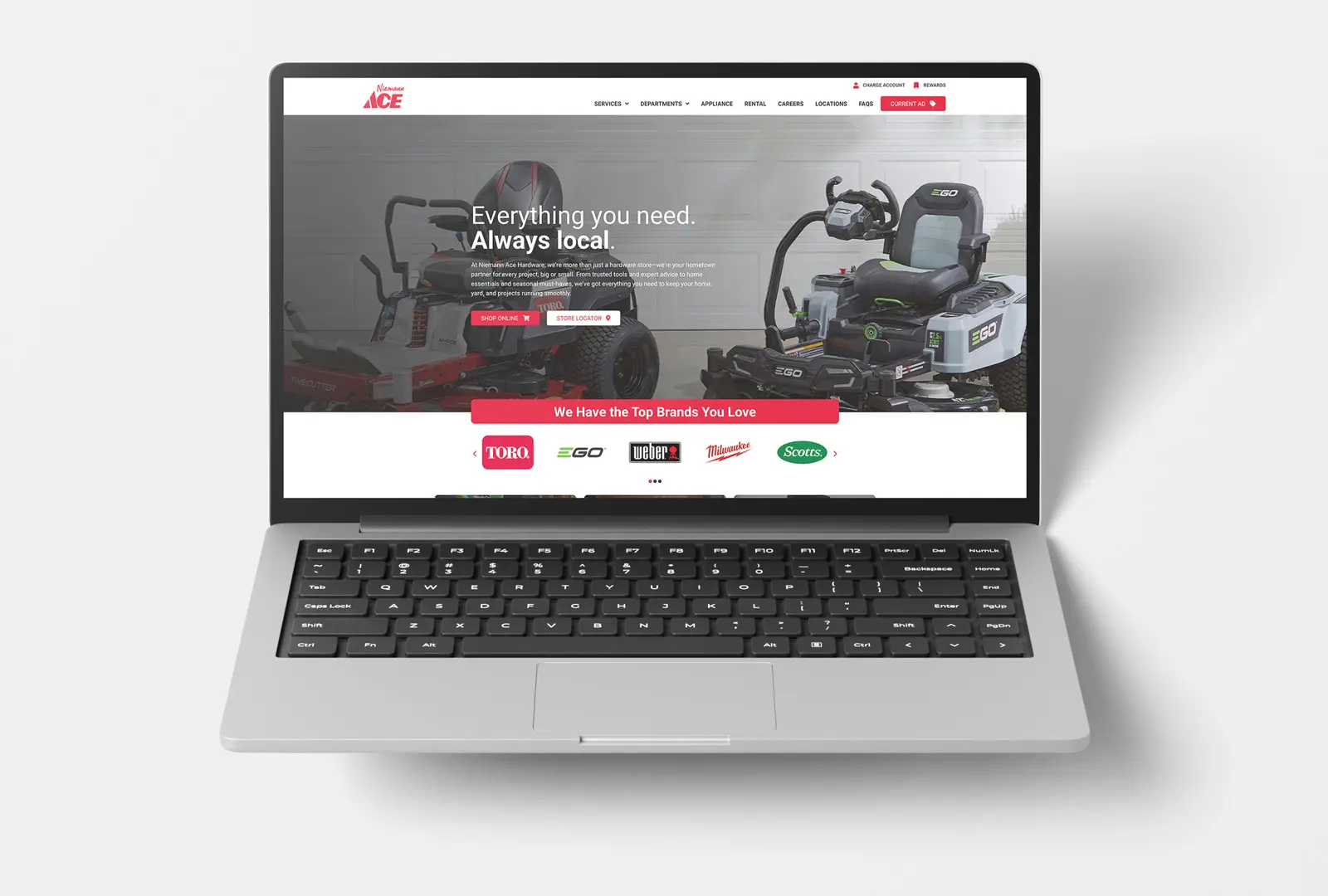
Working alongside Ensemble Creative, The Creative Depot rebuilt niemannace.com around a simple premise: the website exists to get customers into stores, not to keep them on a screen.
1. An Architecture Built Around How Customers Actually Shop
Nobody browses a hardware store website for fun. Visitors show up with a job to do, so the structure mirrors the jobs: services, departments, locations, rental, appliances, careers. Each path is one or two clicks deep and written in the language a customer would actually use. The question “can Niemann do this, and where’s my closest store” gets answered before the visitor has time to bounce.
2. Putting In-Store Services Front and Center
Amazon can’t sharpen a blade. That’s the whole argument for a local hardware store, and the new site makes it loudly. Sharpening, key cutting, screen and window work, and small engine repair each got dedicated pages that explain the service, set expectations, and route the customer to their nearest location. These pages do double duty: they convert visitors into store traffic and they give search engines and AI assistants concrete, answerable content when someone asks where to get these things done nearby.
3. Connecting Local Stores to the Ace Ecosystem
Niemann customers already live inside the national Ace platform: acehardware.com, Ace Rewards, the mobile app, the weekly ad. The old experience treated those as separate destinations. The new site treats them as extensions of the local store, woven into the navigation and page flow so a customer can check the ad, order online for pickup, or manage a charge account without ever feeling like they’ve left Niemann’s world.
4. Telling the Niemann Story
The first Niemann store opened in 1917. Today the company is owned by its associates, thousands of them, which means the person mixing your paint has skin in the game. That’s not a footnote, it’s the brand. The rebuild gave the history and the ownership model real estate on the site, so “Always local” reads as a fact with a century of receipts behind it rather than a slogan.
5. Technical Foundation, SEO, and AEO Readiness
Under the surface, the site was rebuilt for speed and findability: mobile-first layouts for customers checking hours from the parking lot, clean semantic structure, tuned metadata, and local search targeting scaled across a 47-location, five-state footprint. Content was written with answer engines in mind, so when a customer asks ChatGPT or Google where to get a mower serviced in their town, Niemann Ace is positioned to be the answer.
Results
The payoff shows up in how the site now behaves. Task-driven visitors find their answer and their nearest store in seconds instead of giving up. Service pages give every location a competitive weapon the big boxes can’t copy. The Ace ecosystem works with the local stores instead of around them. Search visibility now matches the chain’s actual footprint across five states. And the brand story finally does what it was always capable of doing: making the case that where you buy a hammer matters.
Just as important, the platform scales. As Niemann adds locations, the site grows with the chain instead of lagging behind it.
Conclusion
Niemann Ace Hardware had everything a local retailer needs to win: services the big boxes won’t touch, a hundred-year story, and owners on the sales floor. The rebuild gave all of it a digital home built to convert, so the website now does what every great hardware associate does: figures out what you need and points you exactly where to go.