KOTA CONNECTIONS
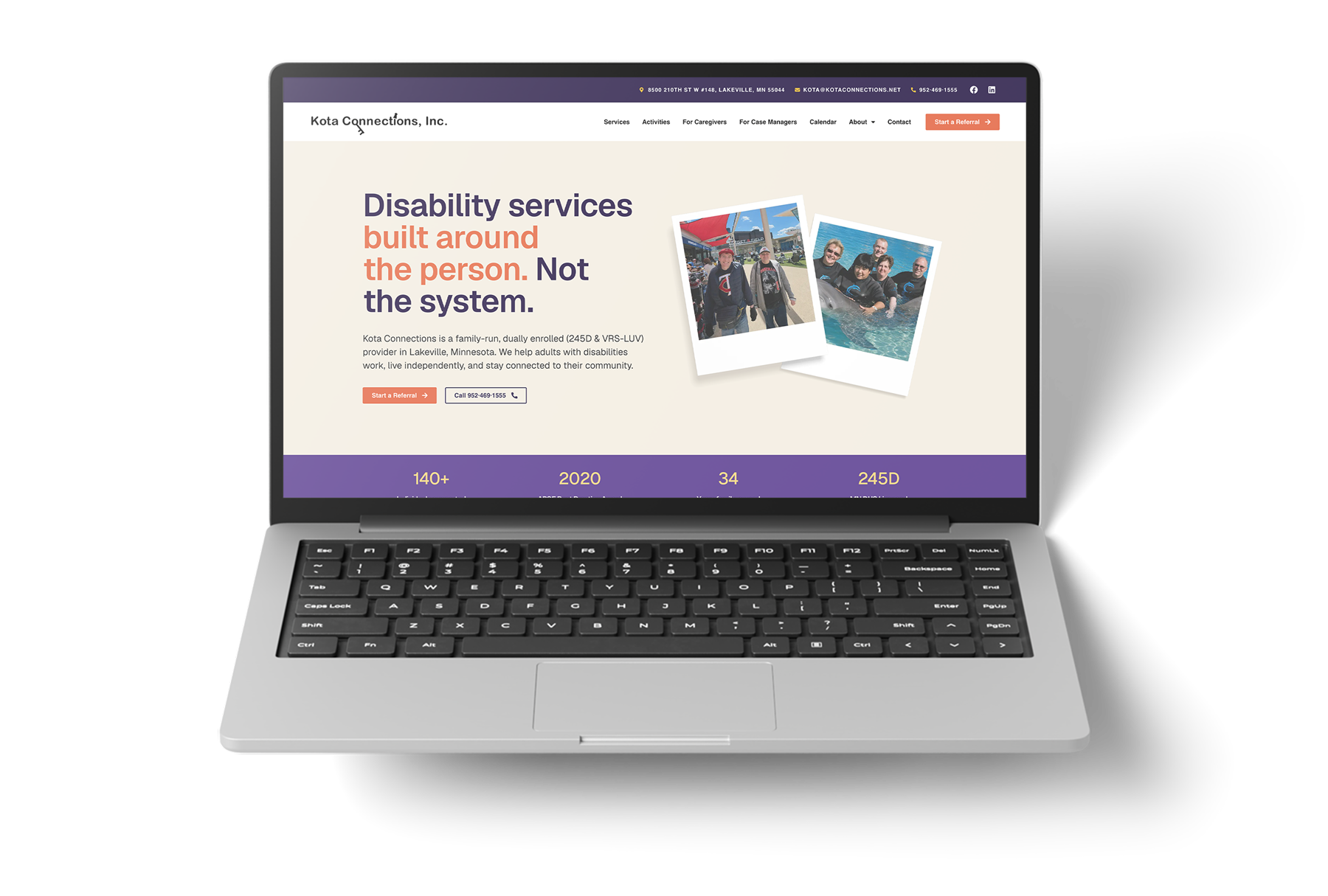
Kota Connections has been doing the same work in Lakeville since 1992: helping adults with disabilities find jobs, live on their own lease, get to medical appointments, and stay connected to their community. Family-owned, 245D licensed, dually enrolled with VRS, supporting more than 140 individuals across Dakota County. The same family that started it still answers the phone.
The problem is that nobody chooses a disability services provider alone. A referral only happens when a case manager, a guardian, and the individual all say yes, and each of them is asking a different question. A case manager needs the license number, current capacity, and a referral process that doesn’t waste a week. A parent needs to know what Kota does, what it doesn’t, and how they’ll hear about their adult child’s day. The individual needs to see that this is a place where they’ll be listened to. The old site answered none of those questions well, and in a category where every provider claims to be person-centered, that left Kota looking like everyone else.
Working alongside Ensemble Creative, The Creative Depot rebuilt kotaconnections.net around the way services actually start: not with a visitor, but with a team.
1. Three Front Doors, One Site
Most people who start with Kota are introduced by a family member, a guardian, or a county case manager, so the homepage splits into those three paths right after the hero. Individuals and families get a plain-English walkthrough of how services work and what a waiver covers. Caregivers and guardians get answers on day-to-day support, medical appointments, and communication. County and case managers get their own page built like a quick-reference sheet: license number, NPI, UMPI, service area, accepted funding, and a four-step referral process that ends at an email address. Each audience lands on the answers written for them instead of scrolling past the ones written for someone else.
2. Capacity and Fit, Out Loud
Case managers make placement decisions on two things a provider website almost never shares: whether there’s room, and whether the client is a good fit. The case manager page carries a live capacity board, updated monthly, marking each of the five core services as open, limited, or drop-ins welcome. The How to Start Services page lists what Kota doesn’t do, in writing: no 24-hour supported apartments, no roommate pairing, no physical personal care, no medication administration. Saying no on the website saves everyone a mismatched intake meeting, and it’s the kind of honesty that earns the next referral.
3. Five Services in the Language of Placement
Employment services, apartment check-ins, medical appointment support, community activities, and the Dakota softball league each get described twice: once for families, in terms of what a week looks like, and once for case managers, in the terms that match a service plan. Visit frequency, staffing ratios, funding sources, and the rotating-team model are spelled out so a referral can be checked against an active waiver without a phone call. Accepted funding, from CDCS to CADI, CAC, DD, TBI, State Waiver, Dakota County, and VRS-LUV, appears on every page where the question would come up.
4. Proof That Isn’t Marketing Copy
Kota’s differentiators are real and specific, so the site treats them that way. Thirty-four years under the same family. A 2020 APSE Organizational Best Practice Award citing a 100% job placement rate. A 245D license continuously active since 2014. A Star Tribune feature on the Dakota County Lyft pilot. Recognition from Dakota County Social Services in December 2024. The homepage puts the numbers up front, and the owner’s own words carry the story: decisions are made in the room, not passed up a corporate chain. A monthly events calendar, a document resource library with the current referral packet, and an FAQ section round out a site built to be cited by search engines and AI answers when someone asks who provides 245D services in Dakota County.
Kota now has a site that works the way a referral works. A case manager can confirm license, funding, capacity, and process in under a minute and send the packet the same day. A parent can read exactly how apartment check-ins run, who rotates through, and what happens when a staff member changes. An individual can see that the people who started this in 1992 are the same people who will answer the phone. Every path ends at the same two actions: start a referral, or call the office.
The structure also compounds. Capacity updates, new calendar events, and new resource documents all slot into the existing pages, so the site stays accurate month to month without a redesign, and every honest answer published is another reason for a case manager to send the next one.
“”
Want results like these? It starts with a thirty-minute strategy call. No pitch deck, no pressure, just a conversation about what your site should be doing.
START YOUR STORY →